I have always been a strong and vocal advocate for education focussed careers within HE, with reward and recognition on a par with research focussed careers. There has been some significant progress made by the sector, with a majority of UK institutions now having a formal career progression route for education focussed academics.
However, I hear from many education focussed colleagues that there is still not parity of promotion, i.e. the progression route may exist, but there is at least a perception that it easier for research focussed academics to demonstrate the criteria for a given level.
One of the issues I hear again and again concerns the requirements around the Scholarship of Teaching and Learning (SoTL). Formally, many educational focussed colleagues are on Teaching and Scholarship contracts (as opposed to Teaching and Research contracts), and scholarship is a requirement for career advancement. This seems reasonable, as promotion criteria and contractual obligations should align. However, there seems to be significant confusion about what scholarship actually means, both to individuals and to promotion panels and reviewers of promotion applications.
There is a whole academic literature on the definitions of scholarship and SoTL, and the differences between scholarly teaching, scholarly outputs, SoTL, disciplinary based educational research and educational research. For those unfamiliar with this literature, as starting points I recommend Trigwell et al., 2000 ‘Scholarship of Teaching: A Model‘ and Kern et al., 2015 ‘The role of The role of SoTL in the academy: Upon the 25th anniversary of Boyer’s Scholarship Reconsidered‘. I like the definition of Hutchings and Shulman (1999), who conceptualise scholarship as “the faculty member must systematically investigate questions related to student learning…with an eye not only to improving their own classroom but to advancing practice beyond it“. This is illustrated in the model of Kern et al. below, which positions Scholarship of Teaching and Learning as being both systematic and public.

Scholarship therefore requires rigour and dissemination beyond an individual’s practice. However, scholarship does not automatically mean conducting empirical educational research, nor does it require publication in peer reviewed educational journals. Dissemination is integral, but the format of dissemination is flexible. The Kern et al. model includes multiple formats of SoTL outputs, of which the peer reviewed empirical research study is only one. Those who are advanced practitioners may be publishing their scholarship in peer reviewed journals and/or conducting original empirical research, but this is not a requirement of SoTL.
At a recent education focussed event I was at, I asked the audience what their institution expected in terms of scholarship. This is not a rigorous exploration of the topic by any stretch of the imagination; I report it as an illustrative snapshot that reflects many conversations I’ve had on this topic over the years.
Of the 23 who responded, there was the following distribution of responses:
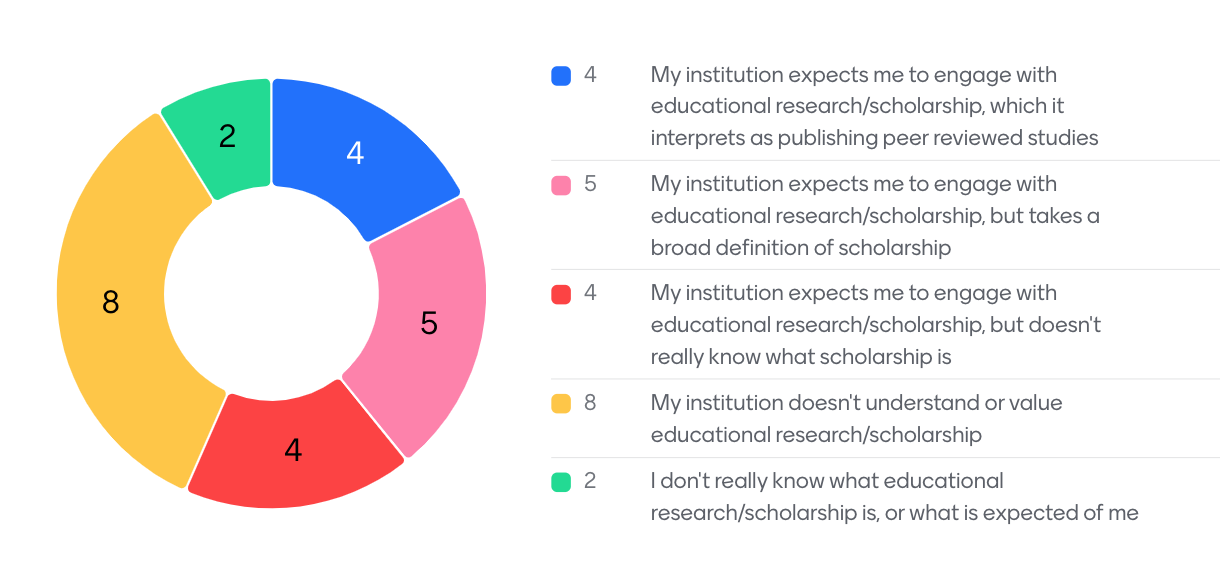
I will leave the institutions who don’t understand or value scholarship for another day, and focus on those who said that their institution expected some engagement with educational research and/or scholarship (13/23 = 56%). Only 22% of participants said their institution took a broad definition of scholarship. 34% of participants said that their institution expected engagement with scholarship, but either interpreted this is as publishing peer reviewed studies, or didn’t really have a clear expectation of what scholarship is.
While this is only a small sample I think it is illustrative of the wider issue. If institutions have unrealistic or unclear expectations about what scholarship is, how are education focussed academics supposed to demonstrate they meet the criteria for career advancement? I know of several brilliant individuals who I would say were engaging in high quality scholarship that makes a positive impact on practice at national level, but have been turned down for promotion on the basis of insufficient peer reviewed publications.
I welcome the inclusion of Scholarship into promotion criteria to enable education focussed academics to demonstrate their activity and impact. However, the sector needs to work together to adopt transparent, inclusive and evidence based definitions of scholarship, so that everyone has a clear understanding of what is (and what is not) required. Without this, education focussed academics will continue to encounter barriers to career advancement, and institutions will fail to celebrate the breadth of educational excellence.
 Dr Katharine Hubbard NTF PFHEA