A lot of my work focusses on inclusive education. One component of this focuses on decolonisation and diversification of the curriculum. Today I want to try and unpick what I mean by these two concepts, and to consider whether it matters in practice or not.
I will first of all put a big disclaimer in here. I am not an expert in these areas. I trained as a plant scientist, not as a social scientist or philosopher. This blog is not intended to be an expert opinion, and I will deliberately point you towards the work of expert thinkers. However, I now get invited to talk about the topics of diversification and decolonisation within my discipline of biology, so am seen as having some expertise here. I therefore think it is useful to share the intellectual journey I’ve been on with these topics to gain at least a working understanding of the key ideas.
Defining terms – Diversification vs Decolonisation
Let’s start with diversification of the curriculum. I think this is relatively straightforward. The curriculum should not present a single perspective or voice, but a diversity of ideas drawn from a diversity of perspectives. Students should feel that they are visible in their curriculum, and see people and experts from multiple cultural backgrounds represented. This is important for all students, not just from minoritised backgrounds. Graduates need to go out into a diverse, multicultural and international society, and everyone benefits from an education that reflects this.
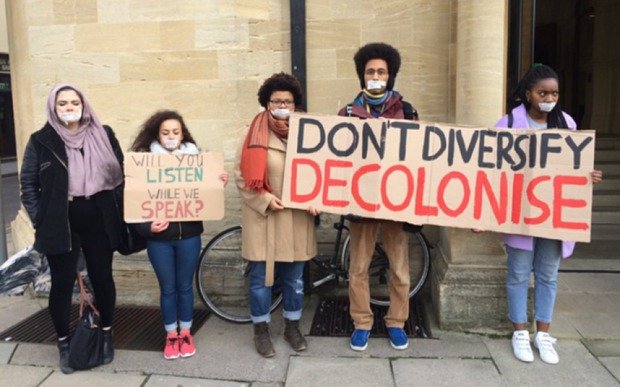
However, many argue that diversification is not enough. The image at the top shows students protesting with a banner of ‘Don’t diversify. Decolonise’. They also equate a colonial university system with being silenced and having no voice. These students see a distinction between the two concepts, and think that the distinction matters. If it matters to these students it will matter to others. So what is the difference?
We cannot decolonise unless we understand what it is to be colonised – Jason Arday
For me, I didn’t really understand the difference between the two until I heard this observation from Professor Jason Arday, one of the leading UK scholars on the sociology of race in the context of higher education. He observes that we often focus on actions relating to the ‘de’ without really understanding the ‘colonise’.
This really helped me to articulate the difference. For example, you could do a fantastic project relating to LGBTQIA+ representation in the curriculum, that was really meaningful for staff and students. This would be impactful diversification, and therefore valuable work. However, it would may not have addressed any issues associated with colonial activity, so is not decolonisation.
It is almost impossible to consider colonialism from a British perspective without also thinking about racism. Throughout the British Empire, colonisation of land was accompanied by implicit or explicit imposition of a racial hierarchy. White people were always at the top of this hierarchy, and Black and Indigenous people at the bottom. This hierarchical mindset justified oppression, from dispossession of land, exclusion from positions of power and enslavement. For me, realising that race was not about difference, about hierarchy and power was really key. Racism is not the only hierarchy associated with colonialism, as those still living with oppressive laws on homosexuality introduced by the British will attest to. However I have come to the conclusion that we have see race and racism as integral to colonialism, and therefore to decolonial activity.
We must also recognise that for many, colonialism is not a historical influence but ongoing trauma. For those in Gaza, Ukraine, Sudan and many other conflict zones this is not intellectual pontification but lived experience. The claiming of land and subjugation of other people is inherently political and violent. Colonialism is fundamentally about power and oppression, and it should make us feel deeply uncomfortable and angry. Against this backdrop, academic debates on terminology must appear irrelevant at best and offensive at worst.
Theoretical underpinnings of decolonisation in education
However jarring it might be at this point, I now want to return to what we mean by decolonisation within education. We are clearly not able to return land to the dispossessed in the context of a university degree. So what are we trying to achieve?
Another hallmark of decolonisation is its underpinning by a robust theoretical framework, which doesn’t get talked about nearly enough. I am increasingly frustrated by talks on decolonisation that do not refer to the key scholars in the field, while claiming to value minoritised voices. As above, I am not an expert in this, but do want to point readers towards some of the key theories and scholars in an accessible way.
Decolonial theory was developed by Latin American academics seeking a robust understanding of the impact of Spanish colonial activity on the Americas. The Peruvian sociologist Aníbal Quijano distinguishes between decolonialism and decoloniality. Decolonialism is the political process of countries becoming independent of colonial power. This contrasts with decoloniality, which is the need to address the underlying legacy of colonial influence on political, legal, economic and educational systems.
Quijano goes further to consider coloniality of power and coloniality of knowledge. Coloniality of power encapsulates the ongoing legacy of colonialism in legal, economic and political structures. For example, the disproportionately high imprisonment rates for Black communities reflects ongoing structural racism. In an educational context however, we are most concerned with the coloniality of knowledge. This refers to the way in which colonial activity shapes what knowledge we produce, value, curate and share. For example, the fact that most of us only read work written in English is an ongoing legacy of colonialism. The British Empire often suppressed the teaching of indigenous languages, and European traditions place significantly higher value on written communication than oral knowledge systems.
A related concept is that of epistemic violence, coined by the Indian literary theorist Gayatri Chakravorty Spivak. Spivak holds that suppression of alternative forms of knowing is inherently oppressive and a tool of cultural domination. For example, the Spanish colonists burned Mayan written materials, thereby destroying knowledge, culture and language. In a more modern context, we can see this in the tendency of Western researchers to rely on local experts but then not acknowledge this expertise let alone form genuine research partnerships. I would previously have described these practices as unethical. However, positioning them as acts of violence and suppression I think perhaps brings much needed urgency and accountability. I’m still working through what I think this framing of epistemic violence really means, but do I think it helps brings clarity over what decolonising a curriculum really is.
Does the distinction matter in practice?
So does it really matter if we conflate diversification and decolonisation? I would never want to discourage anyone from attempting to be more inclusive, or from making their curriculum more representative of the global community. However, I do worry that too much diversification work is done through rose-tinted spectacles and doesn’t really get to the underlying issues. Even though there is a lot more that needs to be done, diversification is easy. Decolonisation is where the hard work is really needed.
Others have also noted the worrying trend of decolonisation becoming fashionable, or as a mechanism of virtue signalling for those who already hold power in the university. I’m probably guilty of this. I raise the visibility of these issues and help colleagues to understand them, but I can’t point to nearly enough real world impact I have made that benefitted those minoritised by the system. I will be changing this. I also need to establish international collaborations with non-Western institutions, and really want to explore what decolonisation of the curriculum means in countries that were or still are colonised.
For me, I think decolonisation of the curriculum should really be about restoring both power and dignity. It should be difficult work. It should challenges deeply held assumptions and beliefs about how society works, and how universities have been integral to colonial understandings of the world. It should make us feel uncomfortable to realise that our own academic disciplines have been complicit in the oppression of other people. We can’t separate out politics from this. Decolonisation is intensely political. To assume this is all about historical injustice is to deny the lived experience and trauma of far too many people. And remember that those experiencing oppression and trauma may include your students, or your colleagues, or people that they care about.
The students in the picture above cared enough about the difference between diversification and decolonisation to protest about it publicly. They considered themselves silenced by universities, so were experiencing that coloniality of knowledge and epistemic violence. That should unsettle us, and challenge us to do more to change the system. Putting up images of more diverse scholars in your field is a great starting point, but it doesn’t do nearly enough. We also need to actually address the persistent inequity we know exists from undergraduate awarding gaps to the severe underrepresentation of Black professors. It is hard to change systems that embed injustice. It should be challenging, it should be unsettling. If you are getting a warm fuzzy feeling from doing this work, I question if you are really decolonising at all.
 Dr Katharine Hubbard NTF PFHEA